All News
2018: The lecture hall occupation and its consequences—in dialog with society
Celebrating ten years of Cyber Valley in 2026

In 2016, important actors from science, industry, and politics founded the Cyber Valley Consortium, which became the first Innovation Campus in Baden-Württemberg. Ten years on in 2026, we're revisiting the most important milestones from the last decade. Each month, we'll focus on a particular year since Cyber Valley's beginning.
This month, we’re looking back to 2018, which marked an important moment for the exchange between AI research and society in Tübingen. From the end of November to the beginning of December, activists occupied a lecture hall in the Kupferbau (a university lecture hall in Tübingen) to demonstrate their concerns with Cyber Valley. They drew attention to the Innovation Campus’s collaboration with private companies and demanded greater public involvement in decision-making and transparency about its research.
The lecture hall occupation demonstrated the public’s interest in AI and the importance of open conversations about its impact on society. To increase dialog between researchers and the public, Cyber Valley launched several initiatives, including the Cyber Valley Public Advisory Board, the Cyber and the City exhibition at the Tübingen Stadtmuseum, the KI-Bürgerrat, as well as numerous public engagement activities from Cyber Valley GmbH.
Engaging the public in AI research: Philipp Hennig, Professor for the Methods of Machine Learning at the University of Tübingen
While the protests came as a surprise to many members of the Cyber Valley Community, they highlighted the importance of public engagement when building Baden-Württemberg’s future with AI. To ensure that the whole of society benefits from Cyber Valley’s research and collaboration with industry, the public needed to be involved in decision-making, as Philipp Hennig explains:
“On a late morning in 2018, I showed up for my lecture in the Kupferbau to find the building occupied. I walked up to the protest camp, interested to see what good cause the students were fighting for. It took a few bewildered moments before I realized that their banners had something to do with me. But I believe the protesters may also not have realized that there was a lecture in the building by and for the very people they were protesting against. At least, they seemed unprepared when I asked them to join me in the lecture hall so we could talk in front of my students.
Over the weeks that followed, I understood this mutual surprise was a metaphor for the situation in town. Students and the wider public did not know or understand what was happening on our nascent AI campus on the hill. And how could they? We had never made an effort to tell them. In our defense, it had not occurred to us that anyone would want to know. AI was still an emerging topic then. Many of us academics, myself included, thought of our work as a nerdy niche.
December 2018 and January 2019 would prove to be a very stressful time. But in hindsight, I am grateful for the experience. Many of my colleagues, from PhD students to professors, stepped up to speak publicly, often in antagonistic settings, about their work, and the often misunderstood administrative details of research funding. Perhaps the most interesting effect of the protests was what it did to Computer Science students. Most of them were initially indifferent. But as they found themselves forced to side with either their fellow students from other faculties or their own professors, many of them became increasingly engaged.
I learned that winter that explaining oneself—in public, and in person—is painful, but worth it. Seven years later, Tübingen may be more harmonious. But the question to our students has only become more pertinent: What kind of world do they want to build with AI?”
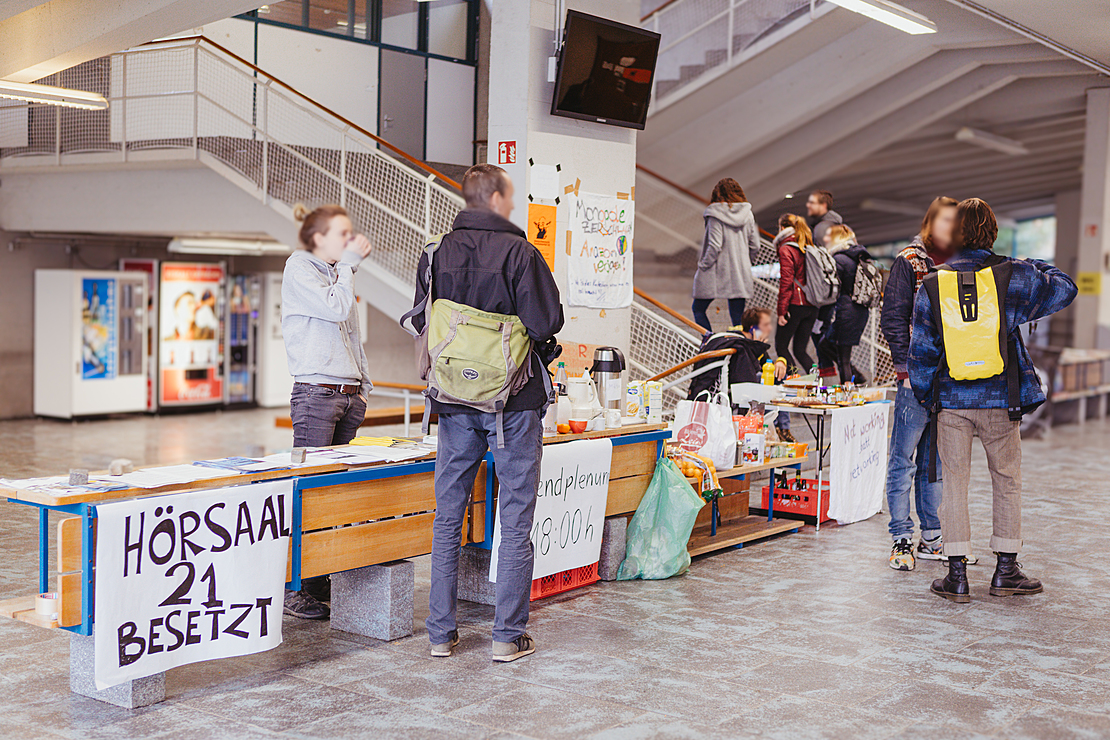 Photo: Friedhelm Albrecht/Universität Tübingen
Founding the Cyber Valley Public Advisory Board: Regina Ammicht Quinn, Senior Professor at the International Center for Ethics in the Sciences and Humanities (IZEW) at the University of Tübingen
One of the outcomes from the protests was the establishment of the Cyber Valley Public Advisory Board (PAB)—an independent committee that critically questions the ethical and social implications of the research projects from the Cyber Valley Innovation Campus. Here, PAB spokesperson, Regina Ammicht Quinn, recounts her experiences of the protests and how they led to the PAB’s founding:
“I experienced the occupation of the Kupferbau as remarkably civilized and cooperative. There were notes everywhere about what was allowed and what was not, chess was played in the afternoon, and the atmosphere was generally characterized by politeness and mutual respect. For example, when I wanted to hold an event in the Kupferbau as part of my lecture series on the topic of "Discrimination by Algorithms", the sleeping bags were unceremoniously put aside so that the lecture could take place. In my opinion, the protesters did not formulate any concrete demands. Rather, they articulated general concerns and fears about the social consequences of artificial intelligence—questions and uncertainties that, in my view, have lost none of their relevance to this day.
The occupation’s aim was to draw attention to problems: next to the main demand ‘Amazon not in Tübingen!’, came calls for greater transparency—especially regarding possible weapons research—and fears of the already difficult housing situation deteriorating further. There were no concrete problems that were easy for the university to solve. Universities are also committed to society, so a lecture hall can sometimes be a place of protest.
The establishment of a Public Advisory Board in Cyber Valley was therefore a necessary and important step. The Public Advisory Board should create the space in which social perspectives, ethical questions, and public concerns about AI research are brought into discussion. The board’s initial responsibilities included reviewing project proposals and making recommendations. It did not expressly see itself as a moral control body. Rather, it saw its role in pointing out that digital research should be more interdisciplinary and that additional scientific perspectives are necessary to broaden horizons.”
Cyber and the City: Thomas Thiemeyer, Professor for empirical cultural studies at the University of Tübingen
The protests also gave an impetus to cultural researchers like Thomas Thiemeyer, who curated the Cyber and the City exhibition at the Tübingen Stadtmuseum. The exhibition ran from February 2023 to January 2024 and gave an overview of the developments and debates surrounding AI research in Tübingen. For Thiemeyer, it offered a space for the public to engage with this topic following the protests in 2018:
“The protests raised some of the big questions related to AI that were little discussed publicly in Germany at the time: Where will our city develop if the tech industry and AI research become central players? What does AI do to our society? How does it change our everyday lives? And which economic models (keyword: ‘surveillance capitalism’) do we support with new technologies? What does this mean for scientific research, whose independence from commercial interests and political expectations is important?
The protests were the reason why we, as cultural researchers, dealt with the topic and finally made an exhibition on it. The protests meant that the topic of AI in Tübingen and Stuttgart became a topic for the people of Tübingen, where fundamental questions of urban and social development were negotiated. Protests are always interesting for cultural studies because they force societies to reflect upon themselves and make corrections.
A continuing dialog with the public about AI research and application is important because new technologies always change people’s lives. These technologies affect all of us and are therefore a subject of political discussion. For these discussions to be conducted not only by a few experts, but by as many citizens as possible, information is a prerequisite.”
The events of 2018 highlighted the importance of open discussions about new technology. AI developments not only raise scientific and technological questions but also touch on societal expectations, hopes, and concerns. This is why it is crucial to create spaces for the exchange of different perspectives.
Public engagement is an important part of Cyber Valley's activities. Various public engagement formats and initiatives promote continuous exchange between researchers and the public—from dialog events and exhibitions to participatory formats such as citizens' dialogues and campus tours. The aim is to make AI understandable, include different perspectives, and consider the social dimensions of new technologies.
To celebrate Cyber Valley's ten-year anniversary, we'll be sharing a variety of content across our website and social media channels reflecting on milestones from the last decade. Stay tuned for the next installments!


Chair for the Methods of Machine Learning at the University of Tübingen
Related Articles


2023: Three new AI institutes at Cyber Valley