 All News
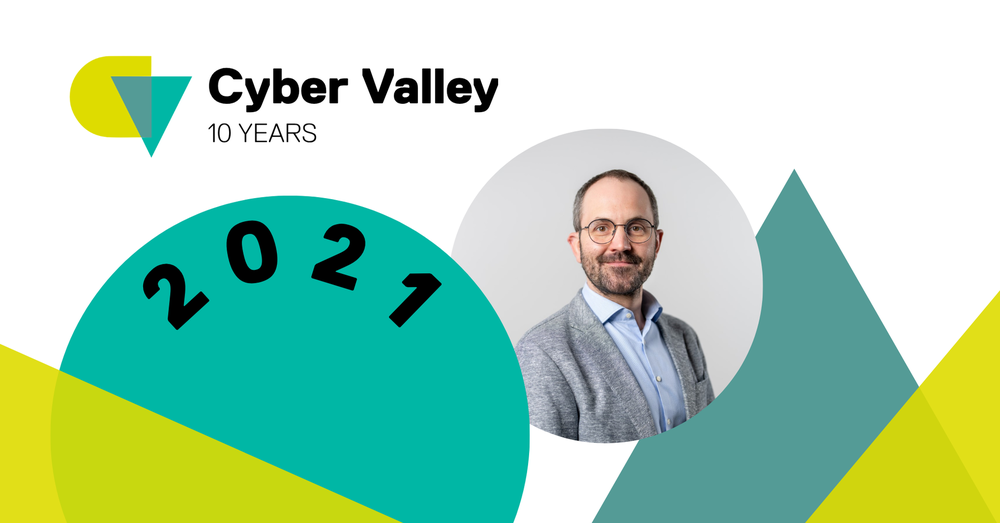
2021: Founding of Cyber Valley GmbH—Interview with Florian K. Mayer
Celebrating 10 years of Cyber Valley in 2026
In 2016, important actors from science, industry, and politics founded the Cyber Valley Consortium, which became the first Innovation Campus in Baden-Württemberg. Ten years on in 2026, we're revisiting the most important milestones from the last decade. Each month, we'll focus on a particular year since Cyber Valley's beginning.
This month, we’re looking back to 2021, when the Cyber Valley initiative transitioned into being a GmbH (a registered German company). Cyber Valley GmbH’s Managing Director, Florian Mayer, had already been deeply involved in the initiative since the beginning and has continued to play a vital role for the company. In the following interview, he reflects on what it was like to work for Cyber Valley at the beginning and how it continues to fulfill its mission of transforming AI and robotics research into a sustainable future for all.
What was it like when you started working for the Cyber Valley initiative? What was its original mission?
When I started at Cyber Valley, there was a real sense of excitement in the air. You felt like you were part of something new and special. That enthusiasm was contagious; many people wanted to play an active role in building one of Europe’s leading centers for artificial intelligence and robotics.
Cyber Valley’s mission was—and still is—to create an attractive and internationally visible ecosystem for AI and robotics. Researchers should not only be able to conduct excellent basic research but also have better opportunities to translate their findings into concrete applications and innovations. Silicon Valley has been and remains an important model in this regard: a place where cutting-edge research, entrepreneurship, and social progress are closely intertwined.
What were the biggest challenges during the transition from initiative to GmbH?
The biggest challenge during the transition from an initiative to a GmbH was undoubtedly the discussions about the appropriate legal form and the future governance structure. Various models, such as a GmbH, a gGmbH, or an association, were thoroughly examined and discussed. Such decisions set the course for the future and therefore had to be carefully weighed.
Furthermore, it is inherently challenging to reconcile the interests and expectations of a large number of diverse stakeholders. In Cyber Valley, universities, research institutions, companies, and public partners work closely together. However, it is precisely this diversity that makes the collaboration particularly exciting and is ultimately one of the ecosystem’s greatest strengths.
What has personally surprised you the most in the journey since becoming a GmbH?
What surprised me most was how well-known and respected the name Cyber Valley had already become in its early years, even before the GmbH was founded. In a relatively short time, Cyber Valley had made a name for itself both nationally and internationally.
I was also impressed by how successfully the partners have managed to attract outstanding scientists from all over the world to the region. This concentration of talent is extraordinary and has played a major role in establishing Cyber Valley’s reputation today as one of Europe’s leading AI ecosystems.
Cyber Valley aims to turn AI and robotics research into a more sustainable future for everyone. What does that mean to you?
This means a great deal to me because I see enormous potential in AI and robotics for Baden-Württemberg, Germany, and Europe. Our region boasts excellent basic research and numerous internationally recognized research institutions. At the same time, there remains great potential to translate scientific findings even more effectively into innovative products, services, and business models.
This is precisely where ecosystems like Cyber Valley can make an important contribution. They bring together science, business, and society and create the conditions that allow innovations to find their way into practical application more quickly. In doing so, they make an important contribution to the future viability of our business location and to shaping technological progress in a sustainable way.
What responsibility do organizations like Cyber Valley have in shaping how AI affects society?
In my opinion, organizations like Cyber Valley GmbH bear a very great responsibility. Technological innovation alone is not enough: just as important is the question of how these technologies are used in society and what impact they have on people and institutions. Cyber Valley GmbH has therefore made promoting societal acceptance of new technologies a core part of its mission. Those who fail to adequately consider the ethical, social, and societal implications of AI run the risk of losing public trust. An important step in this direction was the establishment of the Public Advisory Board back in 2019. This created a framework early on to incorporate societal perspectives and critical questions into the further development of the ecosystem.
What makes the Cyber Valley ecosystem unique compared to other AI hubs?
Cyber Valley is unique because it is not limited to a single location. The ecosystem spans the various locations of its partners, thereby bringing together diverse areas of expertise and perspectives. The participating universities and research institutions have a wide range of scientific focuses, ensuring that a particularly broad spectrum of AI and robotics research is covered.
Added to this is its strong integration into one of the world’s most innovative economic regions. Baden-Württemberg boasts a high concentration of technology-oriented companies, global market leaders, and industrial expertise. This combination of excellent research, international talent development, and a strong industrial base creates ideal conditions for the successful transfer of research findings into practical applications and sets Cyber Valley apart from many other AI hubs worldwide.
To celebrate Cyber Valley's ten-year anniversary, we'll be sharing a variety of content across our website and social media channels reflecting on milestones from the last decade. Stay tuned for the next installments!

Related Articles
2023: Three new AI institutes at Cyber Valley

2022: Hector Foundation supports founding of ELLIS Instit...